
What we need to proceed
The development process is made up of 4 main parts:
- Prototyping (currently well underway in Australia)
- Testing (build and install several units in India for winter season testing)
- Production (design and establish mass production process in India)
- Distribution (set up distribution networks into the remote regions where they are needed the most)
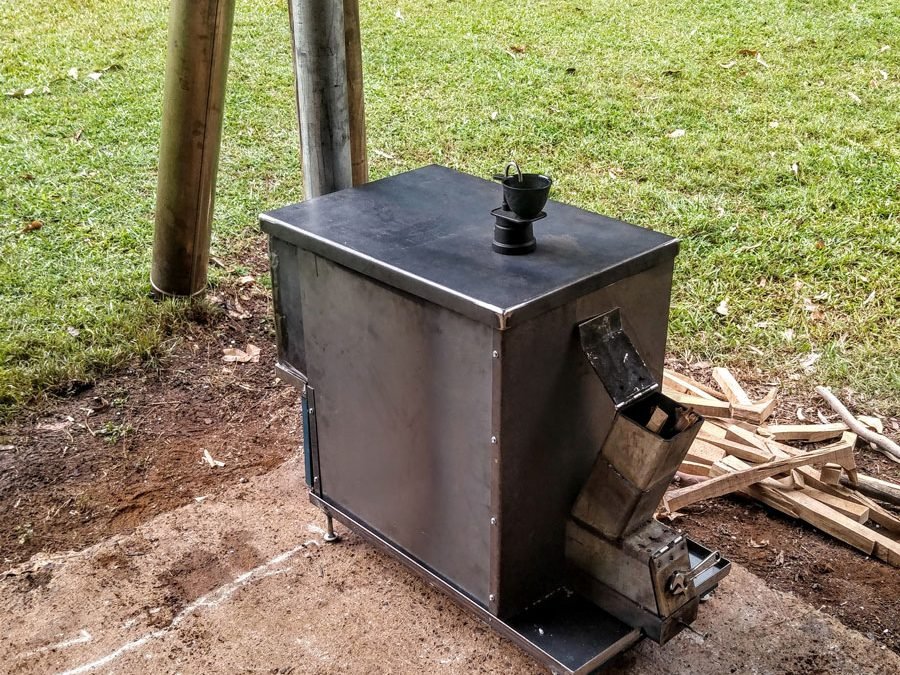
We are currently at the end of the first phase, with various prototypes currently in local testing phase. The results so far have been very promising, with a working unit ready to model our India test units on.
Funds are required to go to the next phase, where we build several test units in India, install them into various family situation in different parts of the Himalayas (with differing parameters) and monitor their performance over the winter.
The Prototyping and Testing Phases have the following steps:
- Research existing designs – (complete)
- Implement design concepts into prototype versions – (complete)
- Test prototypes and refine here in Australia – (in process)
- Take a refined prototype to India for testing on site – (next phase)
The Impact
Market research shows that there are approximately 10 million households (with an average 5 occupants) in the Indian and Nepalese Himalayas. Most of these still use wood stoves in some capacity, either for cooking or heating or both. Even if we only count half of this potential market as being viable…
- 5 million households burning wood inefficiently equates to 1 million mature Himalayan trees per year being consumed.
- If we can reach 10% of these households and replace their stoves, that’s 500,000 Himalayan Rocket Stoves in use, saving on average 100,000 trees per year
- Half a million families with more funds for food, less need to deforest their region, cleaner air and greater self reliability.
- Over the lifetime of this project, our aim is to make high efficiency fuel stoves the norm, with a far higher uptake (than 10%) across the region, and a better quality of life as a result.
Risks & Challenges
Having worked and travelled in India on and off over the previous 25 years, mostly in the travel and tourism sector, I am familiar with the regions and some of the challenges they present.
Challenges
- Doing business in India. There are established systems and ways of doing things that require tact, and at times, a carefully placed donation. Working with an insider who is familiar with the corporate landscape of India is crucial, as navigating the geo-political landscape with all its factions and vested interests requires sensitivity. Additionally it is likely to be a legal requirement to doing business in India that we will need to do so as a Joint Venture, requiring an Indian partner in the local production business. I have several contacts to follow up in this regard.
- Competition and duplication. In a way, we encourage imitation over the long term, for all the associated wider benefits to the people and environment that will result from a wider uptake of this technology. In the short term, we will guard our first mover advantage by outsourcing our manufacturing to different suppliers, so that no other manufacturer ever sees what the completed stove looks like. We can do this due to the unique nature of our distribution plan which is explained in greater detail later.
- Distribution. The Himalayan regions we are talking about are vast, intricate and home to countless culturally distinct subgroups, many of whom do not travel to large centralised “shopping nodes” on a regular basis. Our plan to deal with this is to take the stoves to them, flat packed on trucks with a driver and salesman who is familiar with the language and culture of the region they are servicing. In this way, they will drive from village to village, setting up a tea stop on the side of the road demonstrating their test unit as they go, and selling off the back of the truck. My extensive years travelling in these regions has shown to me the efficacy of this method, and I have existing networks I can call on to step into these roles.
Other Ways You Can Help
This crowdfunding campaign is to get through the testing phase in India, and to further research the production and distribution logistics on the ground in India. We are going to need:
- Your help to spread the word about this campaign and how many trees can be saved if we get this to mass production phase.
- A partner in India (or someone familiar with production in India) who will be able to help us navigate the process of setting up production in India.
- An Angel investor willing to be a part of our team and to help finance the production and distribution phases.
- Join our email list so you can stay up to date with our progress. We will also make regular updates on our facebook page and website.
Recent Comments